
Three years after the shipwreck in Pylos: The burden of survival
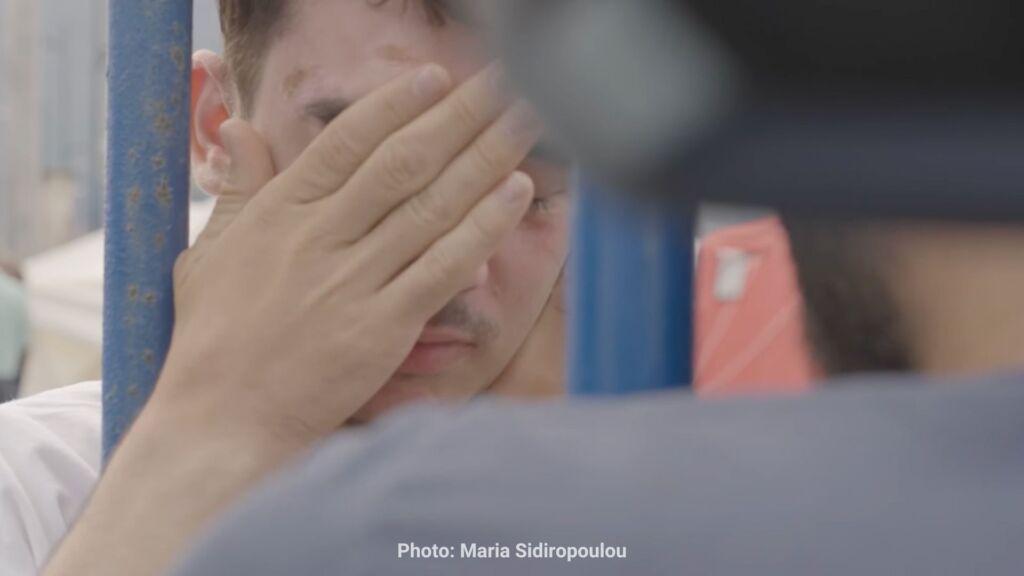
Kalamata, June 2023
Photo: Maria Sidiropoulou
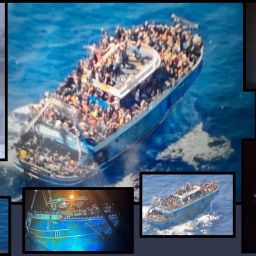
Three years ago, on the night of June 13, 2023, more than 600 people drowned off the coast of the Greek city of Pylos while the coast guard watched for 15 hours and 30 minutes, having refused to rescue them for hours. We spoke with three survivors who now live in Germany. What remains of a night that changed their lives forever?
Firas*, Anwar*, and Karam* are among only 104 men who survived the Pylos shipwreck. All three are from Syria, now live in Germany, and are supported by PRO ASYL.
Firas has been granted subsidiary protection. However, since the federal government of Germany suspended family reunification last year, he remains separated from his wife and three children. Anwar is still in the asylum process nearly three years after his arrival in Germany. Karam’s asylum application was recently rejected, and he faces the threat of deportation to Syria.
All three, along with numerous other survivors in Greece, have filed criminal complaints against the Greek coast guard.
The responsible public prosecutor’s office has since brought charges of serious crimes against 21 members of the coast guard – including high-ranking officers and two former heads of the coast guard. At least twenty of the sixty-two survivors involved in the criminal proceedings are represented by lawyers from RSA (Refugee Support Aegean).
The conversation with Firas*, Anwar* and Karam* was conducted by Agnes Lisa Wegner for PRO ASYL and was first published in German on the PRO ASYL website on 12 June 2026, on the occasion of the third anniversary of the Pylos shipwreck.
RSA published, on the occasion of the anniversary, an updated timeline of developments from the day of the shipwreck to the present. The timeline documents the findings of independent investigations, the findings and conclusions of institutional bodies, the testimonies and current legal status of the survivors, and the progress of the ongoing criminal proceedings.
It has now been three years since the disaster you survived. How are you holding up these days?
Firas: The memory is always the same. Whether it’s January, February, or any other month. I keep seeing it all again and again. The journey from Syria to Egypt, then that terrible disaster. But in June, it’s especially hard.
Anwar: I also feel that it gets more intense as the day approaches. I have very dark thoughts on that day. You can’t forget those experiences.
Karam: For me, the anniversary doesn’t matter much, because I go through the same thing on the 14th of every month. I don’t like the number 14 anymore. Whenever I see a 14 somewhere, I feel terrible.
When we talk about this disaster that’s behind you…
Firas: It’s not behind me! It’s always with me. I carry it inside me all the time. Whenever I’m alone, those images and sounds come back. Both during the day and at night. I always try to go out and not stay alone.
Anwar: I was with some friends a few days ago. One of them was curious and asked me how this disaster happened. And then I started telling the story. It was a shock to me that the pain is still the same. I just wanted to cry.
Karam: I’m speechless time and again. Even when I was at the psychologist’s, I couldn’t really express my feelings. I can’t find the words. There’s a lot inside me, but I can’t put it into words. And then, when I talk about it, I could go on for hours about something that only lasted a few seconds.
You were on the ship, the Adriana, for five days. What stands out most clearly in your memory?
Karam: I remember the many men when I think of that day. I spent five days with them on that ship. Friends, cousins… And they all died, right before my eyes. When the ship capsized, it pulled me down with it, so that at first I couldn’t resurface. With every mouthful of water that went into my mouth, I thought, “Now I’m going to die!” Until I finally took a deep breath and managed to stay above the surface.
And then I saw all the dead bodies. 600 people. It was such a shock that I thought I’d rather have died myself. I didn’t see people anymore, just corpses. They were so close. I saw their faces and looked for my friends in those faces. But it was already too dark to recognize them properly. Like everyone else, I screamed as loud as I could. Again and again, someone pulled me down. That’s why I had to swim as far away from the others as possible.
Anwar: I always think of a child. [He smiles and pauses.] You’ll notice that I smile now and then while I’m telling this story. I do that so I don’t cry. For the first two years, I cried every time I talked about it: When the ship capsized, the water pressure threw me upward—that helped me a lot. I was able to hold on to something. That’s when I saw a child, about ten years old, a boy. He called out to me, begging me to help him. Since I couldn’t reach him, I took off my sweater and threw it to him so I could pull him closer. And we made it; he came next to me. At that moment, the ship suddenly sank. I lost the boy. I looked for him but couldn’t find him. Later, in the small coast guard lifeboat, I kept looking for him. I didn’t see him anymore. It was clear to me that he had died.
Karam: I experienced something similar. A child died near me. He was maybe 12 or 13 years old and was screaming very loudly. I couldn’t help him because my shoulder was severely injured. I knew the child had died when the water started foaming—and his voice suddenly fell silent.
How do you live with these memories?
Anwar: At first, I felt guilty. I always thought I hadn’t tried hard enough. Shouldn’t I have been able to do it? Couldn’t I have saved the boy? And why did I, of all people, survive?
Firas: I hear this all the time: “Why did he survive while the other one died?” My aunt and everyone she knows have cut off contact with me because her son died on the journey. They blame me. That makes it even worse for me. Sometimes I think they’re right. But in truth, I couldn’t have changed it. It was the sea.
Karam: That’s the worst part: The 600 people who died—that’s not just a number. Those are 600 stories. Each of them left behind people who lost someone.
Anwar: This is how I see it: I’m very grateful to God because he saved me that day, while many others died. I always try, especially on this day, to talk to people who want to embark on this journey. To tell them how dangerous it is and that they should not do it. I wasn’t aware of it back then: that I was putting my life in danger.
That sounds like a mission?
Anwar: Yes, absolutely. My God didn’t save me so I could enjoy life, but so that others could learn from me—on all sides.
In Greece, legal proceedings are underway against 21 Greek coast guard officers, some of whom are high-ranking. Without going into too much detail, what do you hope to achieve through the justice system?
Karam: We really hope they’ll be punished. You have to understand: they were right next to us the whole time. But we pulled unconscious people out of the water, laid them on the overturned boat, and tried to help them. We saved them. They just turned on their lights and watched us. And that’s when I thought: “This is the end—. If they don’t save us now, they won’t do it in an hour either.” Did they want to wait until as many of us as possible were dead?
Firas: And it wasn’t just the Greek coast guard. We can’t blame them alone. Other organizations knew early on that we were out at sea. We gave them our location, and yet no one tried to rescue us.
You’ve been in Germany for almost three years now. What is your life like today?
Karam: Unfortunately, there’s nothing positive about this life. I survived this journey, yes, but I’m not safe. My asylum application was completely rejected a few months ago. And my wife and child are in Syria and aren’t allowed to join me.
Anwar: It was a shock to me. I expected something different. I thought I could rebuild my life. I don’t understand the politics here. Why does Germany make it so hard for us? People are brought in from other countries to work here, even though we come from countries at war and could work too. I’ve been here for almost three years now. I learned the language quickly so I could find work fast. I want to start my own business; everything is ready. But without a residence permit, nothing works. Everything depends on this little piece of plastic.
Are you the last one in your group who hasn’t received a decision on your asylum application yet?
Anwar: I’m the last one, yeah. There’s still no answer. It feels like a dead end.
And how about you, Firas? You’ve been granted subsidiary protection. Do you feel safe?
Firas: I’d say, safety—yes, I’ve found that here in Germany. But I can’t find peace. I was told I’d have to wait a year or two, and then my family would be with me. That’s why I came. But then family reunification was suspended. I haven’t seen my wife and our children in three years. I can’t wait any longer. What happened to me was terrible. If they were here, my life would be easier. I need someone by my side to comfort me. A year ago, I was given a kitten as a gift. I named her Zunbol. Zunbol is Arabic and means “new life.” It is so good for me to have her. If family reunification isn’t allowed again soon, I’ll have to go back.
Karam: I feel the same way. All I want is to be able to start over with my family. When I left them, my son was one year old, he was just learning to walk. And now he’s six. It makes me so sad that I can’t be there to experience his childhood with him. But going back to Syria, after everything I’ve been through, I just can’t do that. The war in Syria may be over. But we’re not safe there.
What is your relationship with Germany and Europe like now?
Anwar: That’s hard to say. On the one hand, I’ve met a lot of nice people, some really great supporters, and even some individuals at the social services office who are very kind. A few days ago, a man sat next to me on the train and said, “You’re very welcome in Germany. You belong here, just as I belong here. This is your country, too. Get involved here.”
But of course, I also feel the hatred from many people. Sometimes, when I read something on social media—the comments, for example—I think it would be better if I went back on my own rather than them sending me back.
Karam: We don’t expect much at all, you know. We can take care of ourselves. I don’t want to sit here and get welfare either. I can work. I want to work. If only they’d let me.
Firas: I’m really disappointed. I haven’t found a single day of peace and quiet in Europe. Being here hasn’t done me any good at all so far. So on the one hand, I’m grateful because I was taken in. But I can’t live without my family. The catastrophe we survived doesn’t matter at all here. I would have expected that to be taken into account in the decisions made here in Germany. But it actually just makes everything even more complicated.
** Names of persons have been changed to protect safety and privacy.