Taner Kılıç: “I would do the same again if necessary”
For decades, the lawyer Taner Kılıç has campaigned in Türkiye for the protection of refugees and for human rights. For this dedication, the PRO ASYL Foundation has honoured him with the 2026 Human Rights Prize. In the interview that follows, which was initially published at the PRO ASYL website, Kılıç speaks about his family background, the time he spent in prison and the challenges of refugee protection in Türkiye.
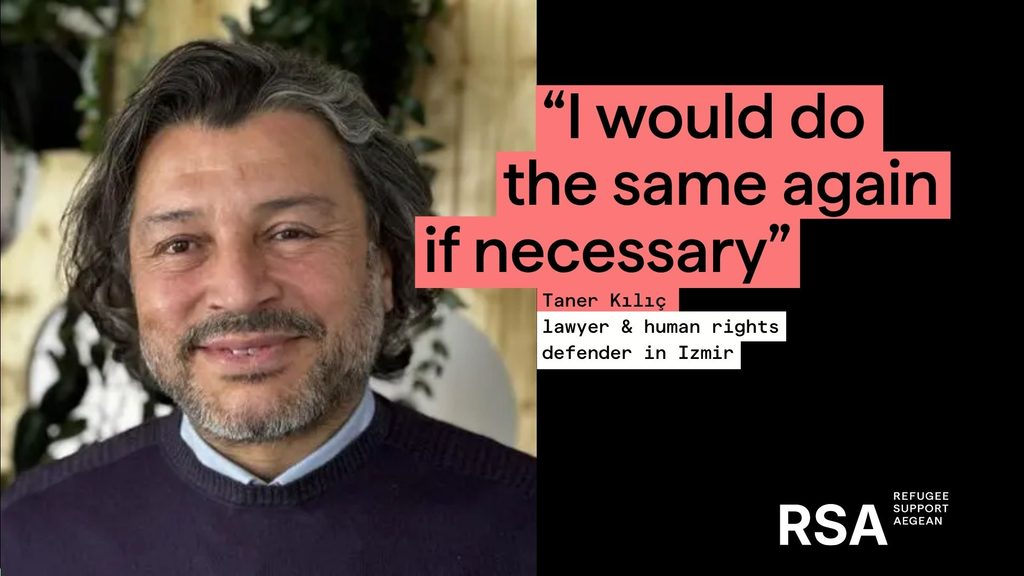
Taner Kılıç,Taner Kılıç, you were born in 1969, studied law in İzmir and in 1993 began working as a self-employed lawyer. Tell us about your first steps. How did you become the person you are today? γεννήθηκες το 1969, σπούδασες Νομική στη Σμύρνη και το 1993 ξεκίνησες να εργάζεσαι ως ελεύθερος επαγγελματίας δικηγόρος. Πες μας για τα πρώτα σου βήματα. Πώς έγινες η προσωπικότητα που είσαι σήμερα;
Taner Kılıç: My father was in the army, but he was not a high-ranking officer. He was constantly transferred to different regions of Türkiye. So during my school years I changed my place of residence every one to two years, and my circle of friends too. That is how I came into contact with people from every corner of the country.
I believe that for other children of military personnel this uncertainty was hard. But I was always able to adapt well to these different environments and communities, and that shaped me.
In 1986 I began studying law in İzmir. There too I met people from a wide variety of backgrounds and ideologies. Perhaps my childhood was the foundation for the fact that, later on, I got on very well with people from different backgrounds and countries.
And what role did it play that your father was in the army? You later took a rather different direction.
TK: I think I wasn’t under my father’s influence all that much. For example, my parents weren’t religious. But when I started secondary school, I discovered Islam. And my parents followed me later.
So you influenced your parents?
TK: It can be interpreted that way. First I influenced my siblings, and later my parents. They changed because of me, yes. Usually it happens the other way round, but in our case it was like this. I was never fanatically religious, though. Over time I found my path. And its foundation is human rights and solidarity with other people.
Does that mean you found your way to human rights through your faith?
TK: Yes, because I believe the two are connected.
And do you remember how you came to the idea of studying law? I
TK: t wasn’t a conscious decision. At secondary school my focus was electronics. In Türkiye, school doesn’t help you to orient yourself towards a career. For university studies, you then had to list several options. In my case they were medicine, electrical engineering and law. I got into law and today I’m very happy about it. If I were born again and studied again, I would choose law.
And during your studies you came across the issue of human rights?
TK: Yes. I read a lot about it. It was also a period, after the military coup of 1980, in which very serious human rights violations were taking place in Türkiye. In my first years as a lawyer, I worked with the human rights organisation Mazlum-Der. That is how I came into contact with asylum law.
At that time, essentially no institution was concerned with refugees. They simply weren’t a topic of discussion, even though they were right beside us. That is why, in the mid-1990s, the UN Refugee Agency (UNHCR) began raising the awareness of other organisations and bodies about the situation of refugees. They invited us, the members of Mazlum-Der, to a two-day seminar in Ankara. There, an Italian woman gave a talk on refugee rights with examples from the Quran. That impressed me greatly. It was essentially the moment when my interest in refugees and people seeking asylum was truly awakened.
Afterwards I did a lot of research, wrote articles and gave talks. Later the Turkish section of Amnesty International was founded, where I volunteered.
And you helped to initiate the founding of the Turkish section of Amnesty International.
TK: Yes, I was one of the founding members and took part in setting it up. It took three years until it was founded. We were 14 people in total, from Istanbul, Ankara, İzmir and Diyarbakır, who met regularly. I then became coordinator for refugee rights. That was in 1997-1998.
Where did most refugees in Türkiye come from at that time?
TK: From Afghanistan and Iran. At that time, the Swiss lawyer and activist Denise Graf of Amnesty International played a decisive role. I learnt a lot from her. Many lawyers in our field call me a teacher, but I must say that the title belongs to Denise Graf. Her ideas and perspectives on displacement and refugee issues remain highly relevant to this day, and we are still in touch.
At Amnesty International I was refugee protection coordinator for around five years. Then we, along with many people who were not in Amnesty International, decided that we had to do even more for refugees. So in 2008 we founded an association in İzmir: Mülteci-Der. It is the short form of Mültecilerle Dayanışma Derneği (Association for Solidarity with Refugees). Until then, as I said, refugee law hardly featured at all, whether for human rights organisations or universities. There was no independent, professional NGO infrastructure whose main purpose was refugee protection.
What was the situation of refugees in Türkiye at that time?
TK: They weren’t protected. The existing human rights organisations dealt mainly with political prisoners, women’s rights and the headscarf. At law faculties, asylum law didn’t exist as a field of study. That means judges and lawyers couldn’t specialise in it, which affected the situation of refugees.
And there was no real reception system on the part of the state either?
TK: From an administrative point of view, there was no protection. But because Türkiye was not prepared for refugees, UNHCR processed asylum applications for a while. Before the war in Syria, that is, before 2011, there were only 10,000 to 20,000 refugees in Türkiye, of whom UNHCR resettled around 10,000 in other countries, such as the US. Compared with today, it was much easier for UNHCR because the numbers were so low.
At that time I got in touch with human rights defenders in Greece. More and more refugees were trying to flee across the Aegean. They suffered ill-treatment from border guards on the Greek side. So I went there several times, and we then founded a new initiative together with PRO ASYL and colleagues from other European countries: Kayiki.
In the first six years of Mülteci-Der, Pırıl Erçoban was director and I was chair of the board. The association grew very fast: it was the first association in Türkiye to focus on refugee protection. Mülteci-Der is an independent civil society body. We are not tied to other organisations, religious bodies or ideologies. In the meantime, the association has become a well-known and very active organisation in Türkiye.
During my time at Mülteci-Der, I took part, among other things, in preparing a draft law in Ankara, which was finally passed by parliament in 2013.
What kind of law was that?
TK: It was the first and only legislation concerning the treatment and protection of refugees in Türkiye, that is, the asylum legislation. Before it, the police were responsible for asylum and migration. The law created the Directorate General of Migration Management (DGMM).
The preparation took five years, until 2013. During that time I was in Ankara very often, even in the final phase before the vote. I also often went to the parliamentary committee dealing with this law and tried to exert influence.
Are you satisfied with the law?
TK: By the standards of the time, I see it very positively. During the parliamentary committee’s work the law kept improving, and it was passed unanimously by parliament, including the left. Over time, though, many amendments were made. Especially after the attempted coup in 2016 and the states of emergency that were imposed, the law became ever stricter.
The law came into full force in 2014, and until then neither lawyers nor bar associations had experience in refugee law. We always expect everything from the state, but organisations and bar associations too could have become active earlier. The İzmir Bar Association is the most influential in Türkiye when it comes to asylum law, and it serves as an example for bar associations in other cities.
Because of my activity in the İzmir Bar Association, I was invited by the Union of Turkish Bar Associations (TBB). Over the years we built, within the TBB, the “TBB Migration and Asylum Commission”, of which I have been chair for the last three years. The commission deals mainly with asylum law and the challenges faced by lawyers working in this field.
What are the biggest differences for refugees between 2008 and today, including in terms of the mood in the country?
TK: At that time, there was no negative attitude towards refugees. When the subject came up, whether with individuals, among the general population or in institutions, people always referred to hospitality and the historical coexistence of different peoples.
It also wasn’t a problem because relatively few people came. For them, Türkiye was rather a transit country, so the situation was different from that in a country of reception like Germany. Türkiye’s EU accession negotiations were under way, the civil war in Syria hadn’t started yet and the atmosphere was fairly positive.
Because of the war in Syria from 2011 onwards, of course very many refugees came from Syria, as well as around a million people from Iraq. Over time, racist parties exploited the issue and stirred up the population against refugees, much as happened in the US and in Europe. That is how a very negative image developed.
In Europe too, we are seeing more and more repression of and attacks against civil society. You are one of the people who experienced this very directly, in prison. How long were you in detention?
TK: I was arrested in June 2017 and released in August 2018. So I spent 14.5 months in prison. At the time I was chair of the Turkish section of Amnesty International. I was known as an activist for refugee rights in Türkiye, including through the media.
Some people in government circles claimed that we, the activists, were trying to provoke conflict between locals and refugees. They tried to criminalise me and to link me with terrorism.
A few days after my arrest, a journalist who was also a member of parliament was arrested. Her daughter worked for a refugee organisation, though not ours. And we didn’t know that she was the daughter of a well-known journalist and politician. But in the media it was presented that way. They accused us of deliberately and actively collaborating against the government.
A real campaign broke out against all kinds of bodies, even against the UNHCR. Many organisations came under ever stricter scrutiny. After the state of emergency was imposed, that is, after the attempted coup in 2016, heavy fines were imposed on associations. Some were banned altogether.
Before that, our work looked completely different. There was a form of cooperation with state bodies, and we were in frequent contact. None of that exists any more today. We are ignored and excluded.
You are married and have three daughters. Those 14 months in prison were a high price, even for your family. Would you take the same path again?
TK: Yes, absolutely. I would do the same again if necessary. I don’t regret my involvement, quite the opposite. I’m proud of it.
I was always very careful. For example, I didn’t take on cases that could cause problems. Before my arrest, in 2017, I worked in a law firm with three partners, and we had worked together for 25 years. Professionally I didn’t take on refugee cases, precisely because I was active in civil society. After my release, my partners no longer wanted to work with me. All my files and my client base stayed there. After 25 years as a lawyer, I suddenly found myself without cases and without files.
That was in 2018. I had to rebuild my legal practice from scratch. In this phase I began taking on refugee law cases as a lawyer, since in the meantime I no longer held a voluntary leadership position in an association. Since then, I have won very significant court decisions, including before the Constitutional Court. When I look back at that period, at my whole path, I can say: thank God. There is nothing I regret.
Is there also a feeling of frustration within you? When you fight for so long and so hard for a cause, and then see how badly refugee protection is faring in Europe and worldwide, what feelings does that provoke in you?
TK: At least we stand on the right side of history. Displacement has existed for as long as people have. There have always been people who were persecuted and had to leave their homeland. And that will continue. The fact that the institutions and the framework of rules created in response to the Second World War still exist is a cause for hope.
Was there anything you learnt about yourself during your time in prison that you didn’t know before?
When I went to prison I was 49. In Türkiye that isn’t considered young. In prison I had time to think about myself and my life, and also about my profession and my family. And overall I came out of it stronger.
Many people learnt what happened to me. I found myself accused, which had a negative impact on my surroundings, even on my neighbours. At the same time, though, I experienced great solidarity and support, especially from abroad. That gave me a lot of strength. And that is why the PRO ASYL Human Rights Prize means so much to me. Seeing that my work is recognised, even internationally, touches me deeply.
Of course, we are currently experiencing setbacks with regard to human rights standards. Racist organisations and parties, above all in the US and in Europe, are instrumentalising the issue. These movements often emerge from economic crises. We see this in Türkiye too. But if you look at history, such phases have existed before and will come again.
If you imagine having a conversation with the 15-year-old Taner, how would he see you? Is there something he would discover in you that he wouldn’t have expected?
TK: I think he would be very surprised. He wouldn’t have expected to become a lawyer, or to fight for human rights.
Wouldn’t he have believed himself capable of it? That he would contribute to such great change?
TK: Yes, exactly. He comes, after all, from a very simple family. We were neither educated nor wealthy. My father was a simple man. He left his village to join the army, but he never became a high-ranking soldier.
Last year there was a large Amnesty International gathering in Prague. Around 500 representatives from different countries came together there. I was invited and delivered a speech. And it was truly a strange feeling. I thought that when my father left his village, essentially to escape, perhaps when he joined the army and became an officer, that was his revolution. And this was now my revolution, that I had come so far. That made me very happy.


