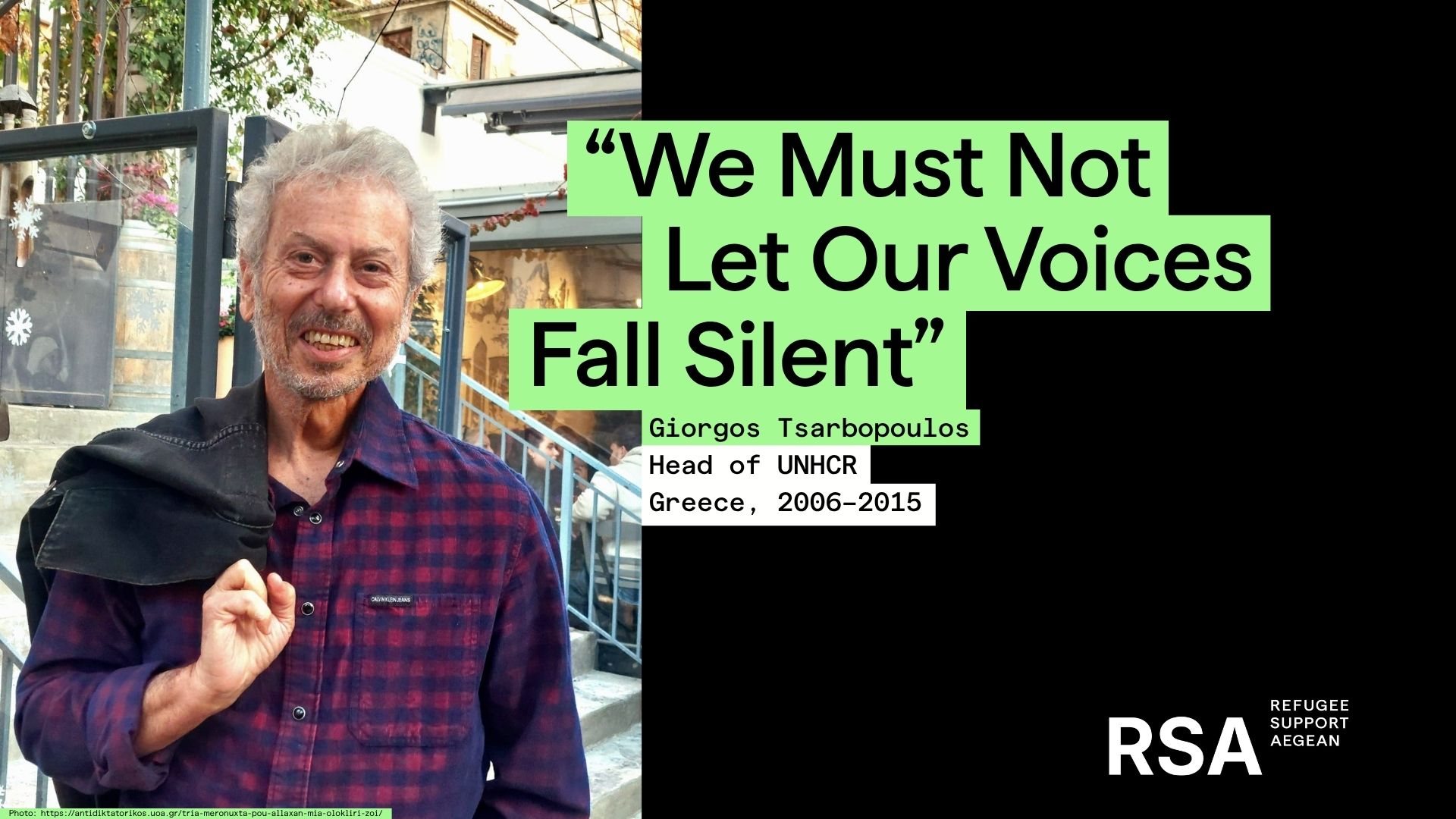
Giorgos Tsarbopoulos: “We Must Not Let Our Voices Fall Silent”
Giorgos Tsarbopoulos has devoted decades of valuable service to human rights and, in particular as head of the Greek office of the UN Refugee Agency (UNHCR), fought unwaveringly for the rights of refugees in Greece. For this work, he has been awarded the PRO ASYL Human Rights Prize 2026. In the interview that follows, which was initially published at the PRO ASYL website, he explains why it matters to raise one's voice, whatever position one holds.
Giorgos, to start us off: is there a story that captures your work as a human rights defender in a representative way?
Giorgos Tsarbopoulos: Giorgos, to start us off: is there a story that captures your work as a human rights defender in a representative way?
Right at the start of my time as head of the Greek UNHCR office, I visited an appalling detention facility. That same day, in the press release we issued, I stated that the facility was unacceptable, violated every notion of human dignity, and had to close. My supervisor at the time, from the Rome office, called me, worried, and said: “Giorgos, that’s not a tone that suits UNHCR.” And I replied: “But it suits human rights. I say what I see.” It should be noted that the detention facility closed shortly afterwards.In your professional life you've experienced - and achieved - an impressive amount. How did it all begin?
GT: After I completed my law studies in the late 1970s, I initially worked with my father, who was also a lawyer. But I had always wanted to work more actively on the international stage. In 1989 I was given the opportunity to work at the Greek Ministry of the Environment, in the field of international affairs and European law – an opportunity I seized immediately. I took part in international conferences on protecting the ozone layer and the Mediterranean. That was the moment my work gained an international dimension.
In reality, though, even then I wanted to work in the humanitarian field. My political consciousness had already been strongly shaped, since in 1973, at the very start of my law studies, I had taken part in the Athens Polytechnic uprising against the Greek military dictatorship. I witnessed first-hand the great transition from dictatorship to democracy in 1974, which shaped my political convictions.
In 1995, I came into contact with the United Nations, more or less by chance. The UN was then looking for Greek lawyers for a mission of the Human Rights Commissioner following the genocide in Rwanda. I was originally meant to stay only two months. In the end it became two and a half years. That’s where I came to know the world of the United Nations and of human rights, and I later worked in Angola, East Timor and Colombia as well.
I didn’t return to Greece until October 2006, when I began working for UNHCR, the UN Refugee Agency. At that time, the UNHCR office in Greece was converted from an international representation into a national office. I was, then, the first (and ultimately the only) head of this national office. I opened the office at the end of 2006 and it closed again during the refugee crisis at the end of 2015. I don’t like speaking of a “crisis”, but in reality, it was one.
How would you describe your relationship with the United Nations?
GT: Showing solidarity with other people gives meaning to my life. For me, it’s very important to struggle alongside others for a shared goal. When you work as an activist in an organisation, as a volunteer, or for a political party, that’s especially obvious: you do it because you believe in it.
It’s a different thing, though, to become part of a vast international organisation like the United Nations. There, it’s by no means a given that you can put your own convictions into practice and keep believing that your work can change something in the world.
Today, though, I know that this is possible even within such a large organisation. The United Nations is extremely bureaucratic, with hierarchies and strict rules. Even so, you can find your own room for manoeuvre. Of course, it doesn’t always work. But when the conditions are right, you can, together with a team, achieve a great deal, even in a difficult or even hostile environment.
For me, then, the crucial point is always to find – or, where possible, to create for yourself – the conditions that drive a team of people to commit to positive change. And that can happen anywhere.
Was this feeling actually present throughout your years as head of the UNHCR office in Greece - the sense of contributing to a better world? Or did it arise only in particular situations?
GT: That’s a very good question. At my interview for the post, the UNHCR regional coordinator in Rome said to me: “You know, this isn’t ‘field work’ – there are no field missions. You’ll get bored. This is Europe. It has nothing to do with Colombia or Africa.” And I replied, with the little information I had at the time: “I believe it is absolutely ‘field work’. After all, we’re on the EU’s external border.”
I came back to Greece with that outlook. I told myself: this isn’t work you can do from behind a desk. If we want to improve the situation of refugees and asylum seekers, we have to be present. And present everywhere, especially at Europe’s external borders – at the sea and land borders, on the Evros, the border river with Türkiye, and on the Greek islands.
The conditions for asylum seekers and refugees were, at that time, genuinely problematic. The recognition rate was practically zero – around 0.1 per cent.
And what was the relationship between UNHCR and the Greek government like?
GT: In the summer of 2009, UNHCR decided to withdraw from the asylum procedure, because we didn’t want to go on legitimising a bad system. The government had promised structural changes, but the legislative amendments it planned turned out, in the end, to be a farce. They didn’t improve the situation.
In the end, we managed to force through a comprehensive structural reform of the asylum system, thanks in part to our withdrawal. In early 2011, Greece created an independent asylum system and open reception facilities at the borders.
It was obvious, then, that the system was so deficient that it had to be fundamentally changed. On top of that, there were all the problems at the borders. There were almost no reception facilities; instead, there were detention facilities and closed centres, where people had practically no rights at all. So there was an enormous amount to be done. We had to develop a comprehensive plan for how refugee protection in Greece could be improved.And we didn’t want to develop this strategy only within UNHCR’s own structures, but in close cooperation with civil society organisations and with refugees themselves. That’s why we built a strong network with the few NGOs active in Greece at the time. We treated them as equal partners, not as organisations that simply had to comply with the UNHCR’s recommendations and guidance.
Is the Farmakonisi shipwreck an example of that?
GT: Yes. In the Farmakonisi shipwreck, in 2014, the Greek Coast Guard had taken a refugee boat in tow in order to push it back into Turkish waters, and the boat sank. Eleven people died.
The government initially claimed the Coast Guard wasn’t at fault – that they had never tied up the boat. Then it was said: yes, we did tie it up, but only to carry out a rescue operation, not as part of a pushback.
How did UNHCR's relationship with the Greek government develop after that?
GT: Whenever we had a presence at the borders, had first-hand information, and were certain that something unlawful had happened, we made it public. Even when governments often denied or disputed that certain things had happened, they were forced to take a position on it.
We insisted that the incident be clarified. The case was brought before the European Court of Human Rights by several organisations, among them lawyers who now work at RSA (Refugee Support Aegean), PRO ASYL’s sister organisation. After eight and a half years, the European Court finally issued its final ruling, condemning the Greek government: the right to life had been violated.
Where were you when you learned of the shipwreck?
GT: In Athens. We immediately sent our colleague responsible for the southern islands, together with interpreters, to Leros, to make contact with the survivors. That’s how we gathered the very first testimonies early on, and in their own language.
That was incredibly important. We were the first to speak with the survivors. As a result, the Coast Guard couldn’t later simply change its account and present its own version of events. We knew the survivors’ statements. That same day, we wrote to the government demanding clarification. At the same time, we issued a press release demanding an independent, thorough investigation.
I went in person to the port of Piraeus when the survivors arrived. And from the very start we worked closely with the civil society organisations that went on to provide the survivors with legal and psychological support.
And before Farmakonisi, was it not yet common practice to take statements from survivors immediately, and in their own language?
GT: What happened was something new. In that shipwreck, eight children and three women died. Before that, we had already documented many cases of pushbacks in which the authorities denied the facts.
When Farmakonisi happened, we weren’t surprised. We knew that sooner or later such a tragedy would occur. Our documentation had shown how dangerous these so-called Coast Guard interception manoeuvres at sea were. We knew, for example, of cases where the Coast Guard deliberately created large waves to stop boats from entering. It was only a matter of time. At Farmakonisi, it did happen: when the Coast Guard tied up the boat and tried to tow it back, it capsized under their control. We made the incident public immediately, the story received major media attention, and pressure was put on the government.
Sometimes, in sensitive matters, it makes sense to send confidential letters, as is often done. But in other cases you have to go public and ask loudly what is happening.
By speaking with the Farmakonisi survivors so early on, you didn't just secure evidence. You also gave voice to people whose voices are often deliberately ignored. That has to do with dignity, too.
GT: Yes, absolutely. I believe this is of fundamental importance, not only in refugee protection, but in every area of human rights, and in humanitarian aid as well. The first thing one has to think of is human dignity. It must come before everything else.
Even when you can’t solve a problem, you have to respect other people and show them that their lives and their opinions matter. And you can do that in many different ways. I’ve sometimes been surprised that people remembered, even years later, that we had made them visible, or simply that we had listened to them. And, quite generally, I believe: when you give something, you always get something back, too.
…as long as you meet people as equals.
GT: Right at the start of my career at the UN, one of the biggest challenges, and, at the same time, an important lesson, for me was how to earn the trust of people who have been traumatised. Whatever background or knowledge you yourself bring, you have to build trust. And that’s incredibly difficult.
You have to leave behind every notion and idea that you yourself know more than others; that whole, slightly neo-colonial approach. That experience really shaped me.
These interactions are also a way of recognising the real impact of one's own work.
GT: Yes. In any case, you always have to stop, re-examine your work, and ask yourself: why am I doing this? Does my work actually have an impact?
Today we’re constantly occupied with implementing programmes and projects, because a donor has made funds available and expects the project to be carried out. In the process, we often lack the time to stop and ask whether what we’re doing is genuinely meaningful, or whether we need to do something differently.
What does impact mean to you?
GT: Impact can mean managing to persuade governments to change their policies. A second form of impact can consist of raising public awareness. And a third is fighting for justice, even if that only happens after eight years, as in the Farmakonisi case. These are three forms of impact we should always keep in mind.
Does that hold equally true for the situation today?
GT: Yes. These thoughts are very relevant today, too. We currently find ourselves in an extremely difficult environment. The general public has grown tired and is no longer especially interested in these issues. At the same time, racism and xenophobia are surfacing much more openly, and we’re experiencing increasingly restrictive European measures, as well as a growing externalisation of asylum procedures. And the rise of the far right and the radical right in Europe must be cause for great vigilance and reflection.
There’s more talk about protecting borders than about protecting people. The issue is increasingly deterrence rather than human rights.
What we’re experiencing today is the loss of things that were won through many years of struggle. That’s why there is a genuine risk that a great deal will be lost in refugee protection. The new EU Pact, for example, contains many problematic elements.
Is there anything that gives you hope today?
GT: I don’t know. As far as European politics and the politics of individual governments are concerned, I’m not optimistic at the moment. But what gives me hope is the fact that, at the grassroots level, you always find people who believe that solidarity matters more than anything else. People who are willing to volunteer and help others. That gives me hope.
That’s why it’s so important for organisations to keep up their presence, even in an environment where there’s a risk of being discredited. We’re seeing people and organisations threatened with legal proceedings because they support refugees in asserting their rights.
What I sometimes observe today is a fear of taking a loud, public stance. But we have to keep trying, again and again. Even under adverse circumstances. We must not let our voices fall silent.


