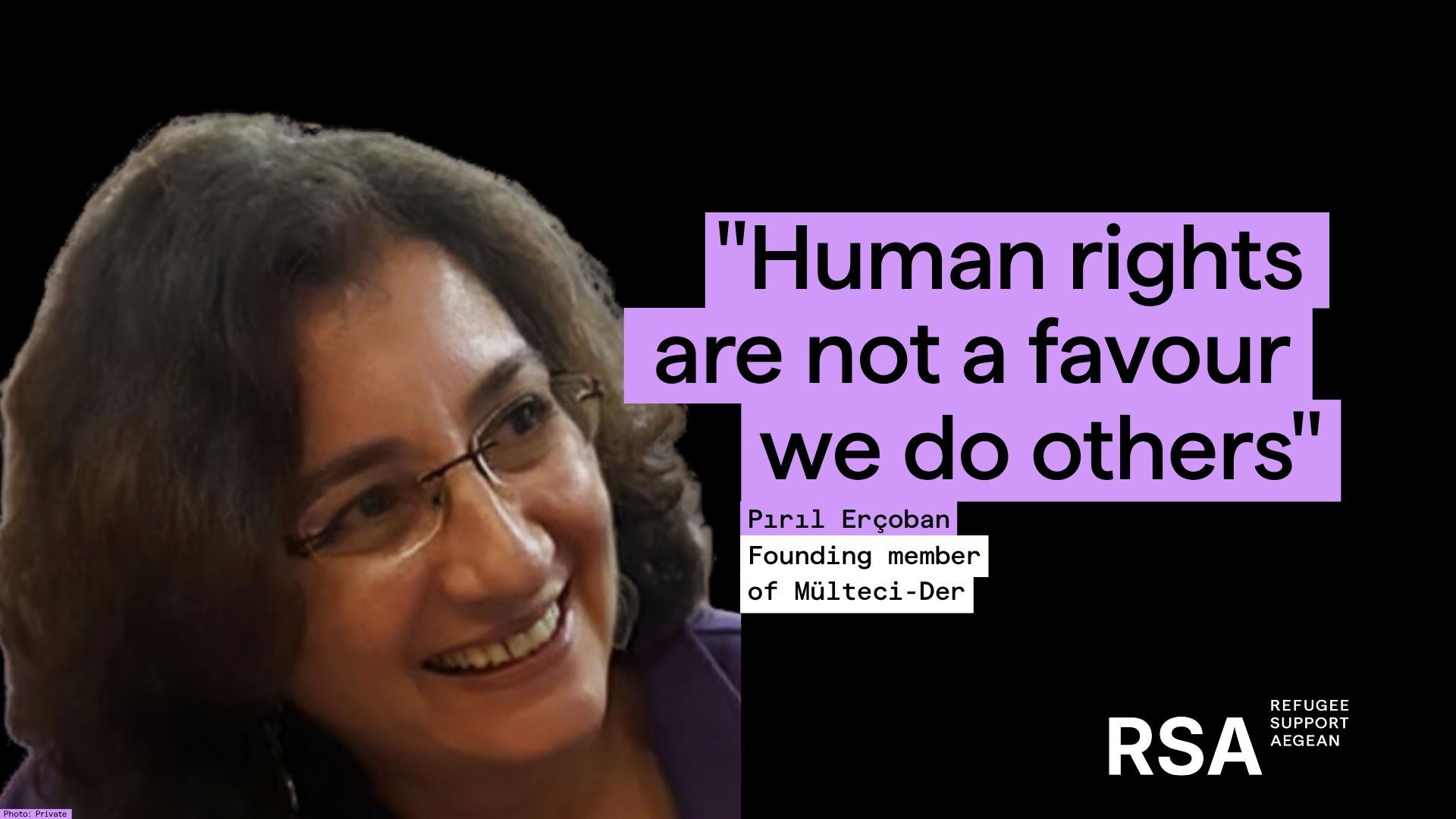
Pırıl Erçoban: “Human rights are not a favour we do others”
Pırıl Erçoban has been awarded the PRO ASYL Human Rights Prize 2026 for her commitment to defending the rights of refugees in Türkiye. In the following interview, which was initially published at the PRO ASYL website, the former director of Mülteci-Der speaks about staying close to those affected, the role of NGOs in Türkiye, and the misunderstood notion of hospitality.
You and your work as a human rights defender - how did it all begin?
Pırıl Erçoban: The beginning, and incidentally also my relationship with PRO ASYL, goes a long way back. I met Karl Kopp of PRO ASYL around 25 years ago. At that time I had just started volunteering in the field of human rights, in particular for the rights of refugees and migrants in Türkiye.
In 2002 I became a member of Amnesty International Türkiye. In the İzmir group we had a team for refugee rights. Taner [Kılıç, also a recipient of the 2026 Human Rights Prize] led that team. In 2008 we founded, that is, Taner and I together with a few other people, Mülteci-Der, in order to be able to work for refugees outside the structures of Amnesty International. Mülteci-Der is the short form of Mültecilerle Dayanışma Derneği (Association for Solidarity with Refugees). I spent most of my professional life at Mülteci-Der, then.
And that was in İzmir?
PE: Yes. İzmir is a hub for irregular movements from Türkiye to the Greek islands. That’s why we had to focus on irregular sea crossings, apprehensions, detentions and deportations. Of course we also had other tasks relating to refugees and migrants in Türkiye, but that was and remains the focus of our work. And it remains a sensitive subject, the hidden side of the asylum and migration field.
What has changed in Türkiye since then?
PE: A great deal. The biggest change is of course the number of refugees and migrants. Around 2008, fewer than 20,000 refugees/asylum seekers were arriving in Türkiye. Today we’re talking about millions. Back then, nobody cared about these people. Nobody noticed them. They lived in the middle of the city centre, people walked past them, but nobody wanted to see them.
Before 2014 we didn’t even have a law regulating asylum and migration. At the time, the word “refugee”, or its meaning, was not known even to most Turkish authorities. Today everyone knows it, the public and the authorities, even though it’s given different interpretations. Sometimes it’s used in place of “migrant”. Others restrict it to Syrian refugees alone.
Can you describe this period of change?
PE: So much has changed. Some of it for the better, some for the worse. With the arrival of Syrian refugees in 2011, interest suddenly surged: the interest of civil society, public bodies, the general public, journalists and academia.
With the arrival of Syrian refugees, we witnessed an influx of enormous EU and other funding for Türkiye – not only to support state work on refugees, but also for NGOs and academia. So everyone wanted to do something in this field.
Through this, people also came to learn the meaning of the term “refugee” – although in Türkiye we still have a problem with the word’s actual meaning. Due to the geographical limitation to the 1951 Refugee Convention that Türkiye has maintained so far, the term ‘refugee’ is used only for citizens of the members of the Council of Europe to seek asylum in Türkiye. For many years, even state officials called them “our guests”.
They were treated as guests – guests whose reception we expected to be met with gratitude. We allow them to come to our country, to live here for a while, to be polite and nice, to follow the rules, not to speak loudly or ask for too much. And then they are to please return to their countries of origin. That was the general view of refugees, and honestly, it essentially still is. And this applies to public bodies and the general public alike, even to NGOs and lawyers. As if they were doing something out of generosity, out of charity or humanitarian feeling.
How should it be instead?
PE: For years we have been trying to convey this: that it isn’t about whether we are good or generous towards refugees. It’s that the right to asylum is a fundamental human right. And no one has the right to limit it by acting as though we were the owners of a house, allowing our guests to stay with us for a while. We are trying to change that perspective.
When you talk about convictions and ideas: what shaped your own? What influence did your family, your childhood, have?
PE: I hadn’t thought much about this until now. But yes, my family definitely shaped my outlook. My mother worked, which was unusual for my childhood in the 1960s and early 1970s. She worked in healthcare. It wasn’t easy for her to balance raising us, the household and her job. But I think she managed it well. And she was known for her courtesy and for the support she gave the people around her.
My father also worked in healthcare. After marrying, he became a lawyer. In Türkiye we have a patriarchal society. He always had the last word. But he was a good father. He didn’t put pressure on us and didn’t restrict me or my siblings – I had a carefree childhood and youth. Then, from 1982, I studied at the Faculty of Political Science in Ankara, a fairly significant faculty at the time.
What did you study there?
PE: International relations. Afterwards I went to England on a state scholarship and did my master’s there. My time there helped me broaden my perspective. In Türkiye human rights has been a sensitive issue back then and now. And often, only those directly affected by human rights violations got involved in human rights work.
The years after the military coup, that is, after 1980 as well as the 1990s were a very difficult period for Türkiye from a human rights perspective. After all those difficult years for the country, I thought I should do something in this field; that is, join a civil society organisation. So I became a member of Amnesty International. I was at university, first as a research assistant and then as a lecturer in those years.
My father worked as a lawyer in administrative law. In the 1980s, that was probably the field in which most breaches of the law took place. Many civil servants were removed from office, and there were human rights violations. My father was also active in civil society and in political parties. His stance and his perspective inspired and encouraged me.
And your mother's personality.
PE: Although there was something about it I didn’t like: she wasn’t selfish enough, she gave a bit too much of herself to others. And I believe one also has to set boundaries.
Something many people working in this field find difficult. Are you good at setting boundaries?
PE: No, of course not, especially not in the early years. The issues of my work were in my dreams, in my everyday life, on holiday, in every private conversation. For a long time I couldn’t eat fish or seafood from the Aegean, because there have been and continue to be so many shipwrecks involving refugees. And I couldn’t swim. I mean, I love swimming, but for a long time I really didn’t want to swim anymore.
Over the years I learnt to manage it. Perhaps you become more selective about what deserves your attention, and when. Even so, although I am now retired, I can’t disengage from the subject.
Do you remember a particular moment when you decided to work for and with refugees?
PE: Yes. Taner had a big influence on that. He was the volunteer coordinator for refugee protection at Amnesty Türkiye when I joined the İzmir Amnesty group. Right at the start we had a case I will never forget: an Afghan boy, 16 or 17 years old, was apprehended and was due to be deported to Afghanistan. Legally I wasn’t well prepared, but in the Amnesty group we had discussed applying to the European Court of Human Rights.
So I suggested to Taner: “Why don’t you file an application with that court?” And he said: “Okay, will you help me?” I said yes, I could help fill in the form. I had no idea how difficult it would be. I thought it would need only the name and the summary of the event, but it did not. Anyway, that night I filled in the form, and Taner submitted an urgent application to the court in Strasbourg on the day of the scheduled deportation. And I believe it was the first case in Türkiye in which the court granted an urgent application within four hours. I was over the moon, completely overwhelmed. It was our first case, and we managed to stop the boy’s deportation.
Karl Kopp of PRO ASYL, as well as our wonderful colleagues in Greece, Marianna and Natassa of RSA, supported this case. I believe the young man is now possibly in Austria. In any case, this case brought us together with our colleagues in Greece and Germany.
What is the situation today, now that there is an asylum system and legislation?
PE: It’s more difficult today. We thought a law would lead to some kind of standardisation, that everyone involved would know what to do. But now everything is much more complicated and unclear. Looking back, I think things used to be easier, and more humane.
After the EU-Turkey Deal of 2016, Türkiye’s role as gatekeeper became clearer. Europe showed itself very generous towards Türkiye, so that refugees would be kept outside Europe’s borders. That was the core of the deal. Refugees were used by Türkiye and the European Union as a tool of foreign policy. But not only in foreign policy, they are now used as an instrument for domestic political purposes, too.
In the meantime, Türkiye has become something like the EU's gatekeeper. What do you think of the role Türkiye plays for the EU today?
PE: Türkiye is not just a gatekeeper for Europe. It used to be a transit country. In the meantime it has become a destination country, even though the Turkish asylum system is based on temporary solutions. It can grant people international protection, but allows them to remain in Türkiye only until they are resettled in a third country or return to their countries of origin. The system offers no durable solutions to people from non-European countries.
In particular, people from Syria, who to this day remain by far the largest group among refugees, realised, after around two years in Türkiye, that they could not return home soon, but that it was also almost impossible for them to build a new life in Türkiye. So they sought regular or irregular routes to Europe. The first major shipwreck involving Syrian refugees occurred in the summer of 2013. I believe 63 Syrian refugees lost their lives. Unfortunately, shipwrecks and pushbacks did not stop there; they continue as long as irregular movements persist. This is because people are not provided with legal channels and durable solutions to rebuild their lives.
What is the situation for NGOs and human rights defenders in Türkiye today?
PE: There is great suspicion towards NGOs and activists. Those working in human rights and/or asylum and migration fields in particular are under constant suspicion. NGOs are expected to fill the gap where the authorities point out, to avoid any criticism, and to behave themselves. Criticism is not welcomed. The authorities cooperate with organisations they trust politically, but suspect the others to be ‘the enemies of the state, of the family, of our values’, etc. Because of their civil society activities, human rights defenders are being persecuted, and some are held in custody or in pre-trial detention. This puts great pressure on civil society and causes people to avoid civil society organisations.
In what way were refugees instrumentalised for domestic politics?
PE: I’m thinking mainly of the 2023 elections. In my view, Erdoğan’s governing party initially did not want to further fuel hostility towards refugees, despite its inability, or lack of will, to manage the situation appropriately.
It was mainly the opposition, though, that used the issue to stir up sentiment among the public. While the government could be criticised on many counts, its initial refugee policy was undeniably positive: the open-border policy towards Syrian refugees, temporary protection status, and the refugee camps were initially assessed by many foreign observers as impressive.
From 2019, however, the situation changed quickly. The opposition claimed the government was giving refugees everything it had. This may not have reflected reality, but it was believed by a section of the population. At the same time, tensions grew: refugees stayed longer than expected, while Türkiye’s economic situation deteriorated.
The pandemic made the situation worse still. Unemployment, rising rents and inflation meant that both locals and refugees increasingly suffered from the crisis. Even so, refugees were blamed for the housing shortage, job losses and inflation. Many opposition parties deliberately exploited this climate for their own political purposes.
As a result, the government’s stance also became increasingly negative, evidently out of fear of losing voters. Hate speech and discrimination against refugees became, in this way, increasingly normalised.
Today the issue is no longer at the top of the political agenda. With the next elections in view, however, I believe it is likely to become once again one of the central issues of political debate.
From around 2020, the government intensified controls on NGOs, particularly organisations with foreign funding and those working in refugee protection and human rights. Inspections and fines increased. While many NGOs provide mainly humanitarian assistance, organisations taking a human-rights-based approach face even greater restrictions. Mülteci-Der is one of the few organisations working for the human rights of refugees and migrants; in other words, it has a rights-perspective when working for refugee protection – that is two reasons in itself to be treated with suspicion.
What role did this direct contact with refugees and migrants play in your everyday work?
PE: I could almost never visit people in detention. Only lawyers are permitted to do that. But apart from that, I tried to stay as close as possible to people. There’s no other way, if you want to provide counselling and support people individually.
Refugees and migrants were also our main source of information. We often learned about changes in practice earlier from the people we served than through official channels. At the same time, people placed their trust in us, and we always did our best to provide our best. But there is no single, transparent system; arbitrary or untransparent implementation is common. So when we think we know how something works, it sometimes turns out to be completely different.
And you often then have to live with the fact that you disappoint people.
PE: Yes, sometimes they lose their trust in you. But if they at least feel that you are sincere and that you’re genuinely trying to do something for them, then I believe a relationship based on trust develops.
The most wonderful thing about working with refugees is that sometimes, after a very long time, you hear from them again. They’ll say: “We’re here, we’re doing well.” Or: “We miss you. Thank you so much for your support.” That is, for me, the most wonderful gift.
If we think for a moment about the future: what, in your view, is needed to protect human rights?
PE: What’s needed is for all of us to internalise the idea of human rights. Human rights are not a favour we do others, not a form of charity. No. They are our duty. It is the responsibility of every state, and of every individual, to grasp that.
It’s a mission, perhaps even an impossible one. But we have to do our best, each of us, starting with our own surroundings.


