
International Day for the Elimination of Violence Against Women 2026: “The most subversive thing a woman can do is talk about her life as if it really matters. It does.”
The story of Latifa*, a survivor of gender-based violence who was forcibly returned to Greece
25 November marks the International Day for the Elimination of Violence Against Women. This year, RSA (Refugee Support Aegean) is sharing the story of Latifa* (22), a beneficiary of international protection who was recently deported from Germany to Greece. A survivor of domestic and gender-based violence, Latifa* continues to face repeated threats from family members, some of whom live in Greece. Her experience highlights the rights violations and dangers faced by single women who have been granted asylum in Greece, particularly when they are forcibly returned from other EU countries.
Today we want to give Latifa* space to tell her story, to talk about her life and the violence she fears and is threatened with in Greece. To protect her safety, we are not sharing further details of the gender-based violence she has survived. Latifa* is legally represented by RSA, which was contacted by her friends in Germany seeking legal support on her behalf.
“I hate it when somebody tells me that I am a strong woman. The judge in Germany told me that I could go back to Greece for that reason. She said: ‘You are strong. You learned the language here. You went to school. If you managed to live here alone, you can also do that in Greece.’ I had told her that I am also under threat in Greece. In Germany I had my teachers, my social workers and my friends. I was protected by a support organisation for survivors of violence, I was going to school and I knew the language. I already felt a bit protected and a bit at home. In Greece I have nobody. But the judge told me that I would probably be safer in Greece, as no one would know where exactly I was after the deportation. I was only crying. Nothing she said made sense. I felt I was being punished for trying my best to overcome all my problems.”
Note: The quote “The most subversive thing a woman can do is talk about her life as if it really matters. It does.” is from Mona Eltahawy, an award-winning Egyptian-American feminist writer and commentator. One of her key messages is that “angry women are free women”.
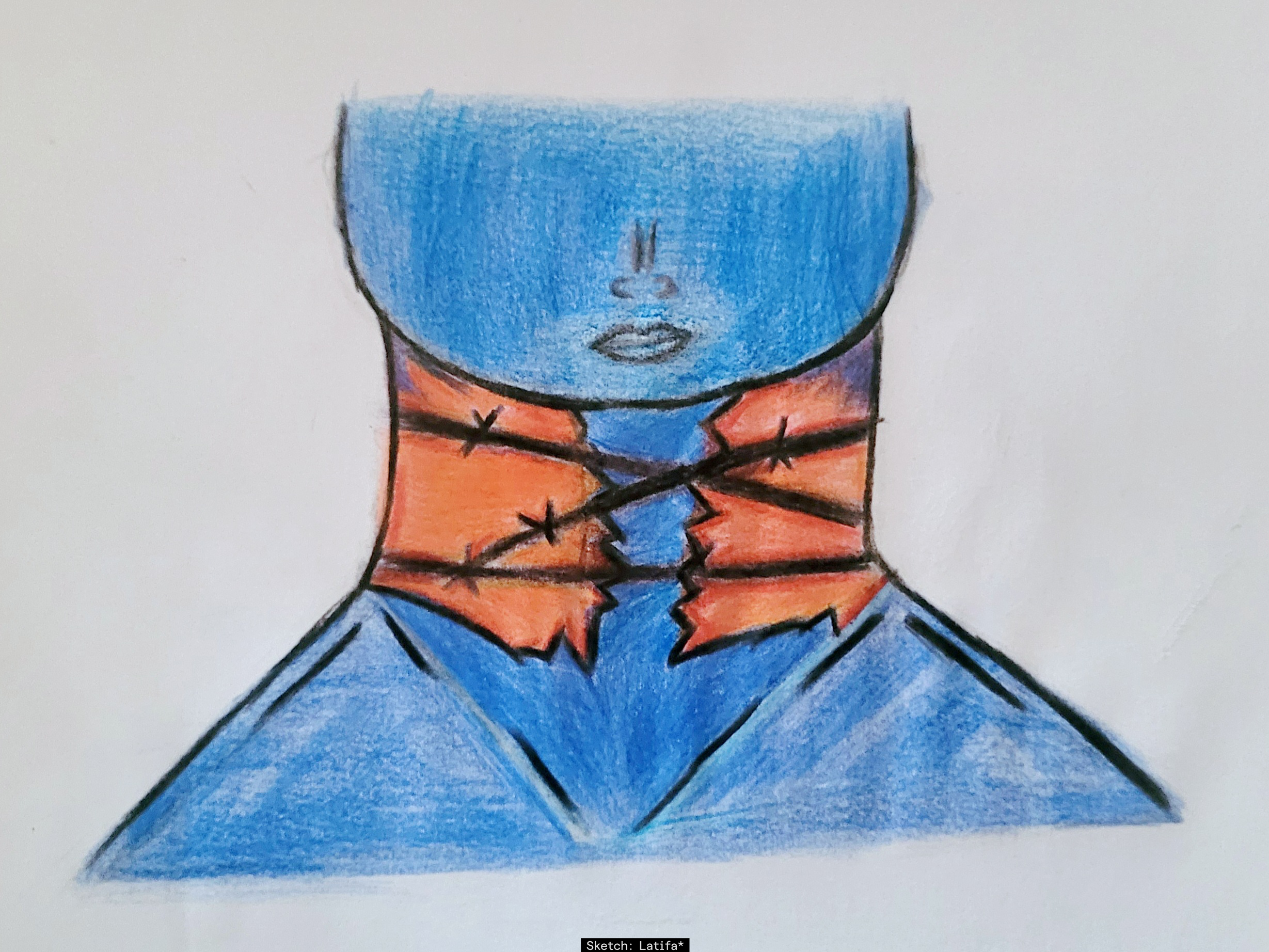
No AMKA, no panic button! Arbitrary barriers to documents, housing and protection
Latifa* was forcibly returned to Greece and arrived in Athens in September. Upon arrival, having lost her Greek residence permit and travel document, she contacted her friends in Germany for advice and support. The following day, she approached the competent Greek authorities at the Ministry of Migration and Asylum, informing them of her return and homelessness and requesting safe accommodation. She also reported the loss of her documents.
She remains without a safe home or official documents to date. Her residence permit, which she had already lost, has since expired, so it now also needs to be renewed through a different administrative practice. The Greek Asylum Service told her that she needed to provide a homelessness certificate from the municipality to renew her residence permit and obtain an asylum status statement. As a result, she cannot obtain a social security number (AMKA) or TAXISnet credentials and she is unable to work or rent a home.
Her attempts to access a shelter for survivors of sexual and gender-based violence have been severely delayed by language barriers and difficulties in obtaining the health examinations required for admission. Despite recent instructions from the Ministry of Health ensuring that women survivors of gender-based violence can undergo these examinations in public hospitals regardless of insurance status, doctors initially refused to carry them out or issue the necessary medical certificates because she did not have an AMKA. The alternative route to emergency accommodation is to report the violence to the police and convince them that she needs a safe house. Ironically, even to have the so-called “panic button” installed on her phone, enabling her to contact the police directly in case of a threat, Latifa* needed an active health insurance number.
At the same time, the threats she faces from her relatives mean that she cannot seek support from other people from her country and must even avoid people from her community. This prevents her from seeking help from the very people she could communicate with in her own language. Potential informal social networks are therefore a threat rather than a source of support. She faces a paradox: she has to avoid people from her community to keep herself safe, yet needs others in order to stay safe, for example to find somewhere to sleep or work.
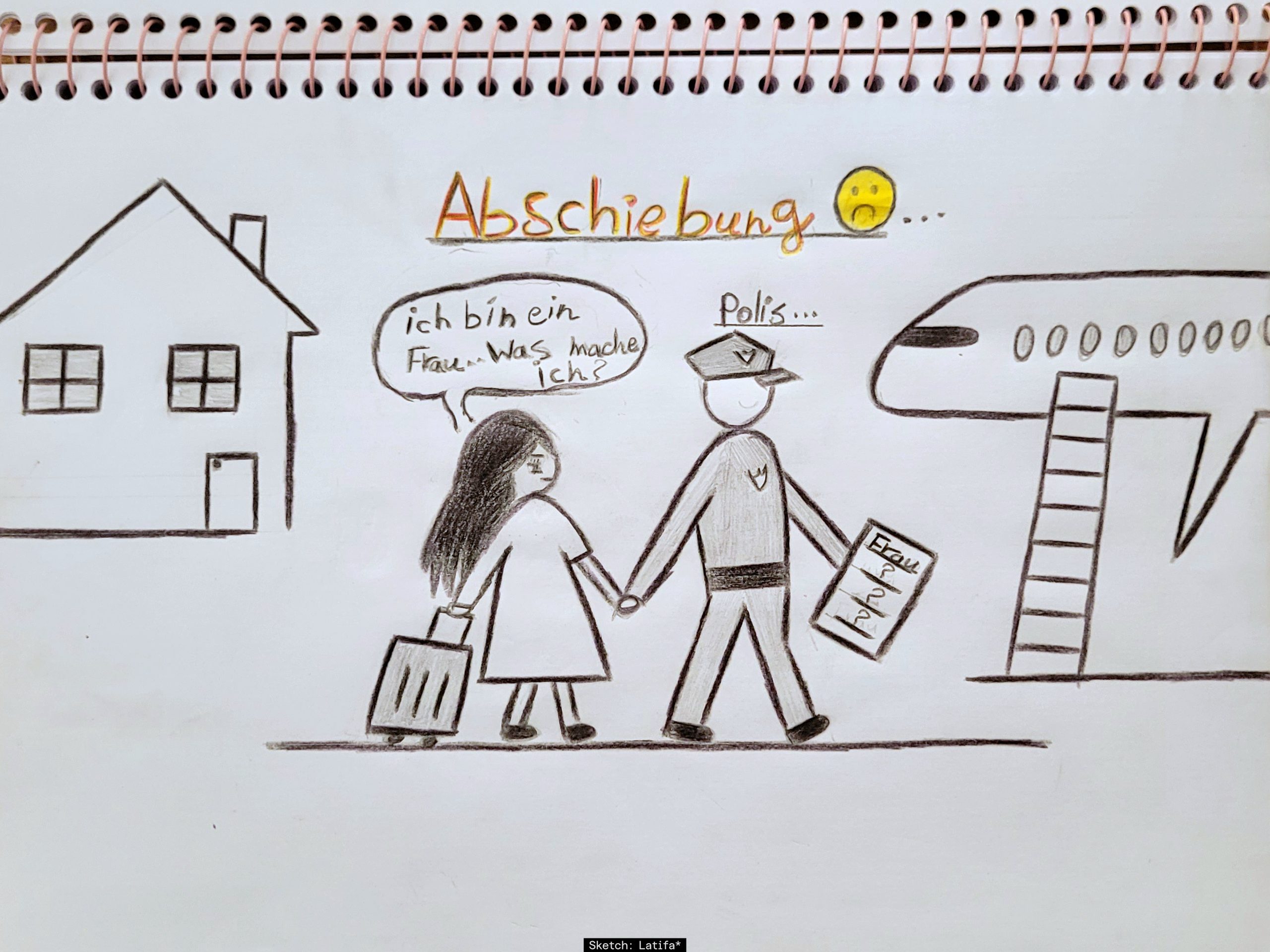
Latifa* tells the rest of her story in her own words:
“I cannot come to school today. I have ‘Abschiebung’ (deportation).”
For more than eight months after the rejection of my case in Germany, I felt my life expired together with my papers. Every night I was staring at the door, thinking the police might come any second to deport me. I was afraid of my family, afraid of deportation. All doors had closed in front of me. Then they came, at 3 o’clock in the morning. I was asleep because I had to go to school. I could see three officers. They said: “You are being deported to Greece. Pack your bag quickly.” I was very calm. I only asked if I could inform my teacher that I wouldn’t be able to come to class. They told me: “Later!” One officer said he was sorry he had to deport a single woman. They put ankle cuffs on me until the airport. Then they briefly gave me my phone so that I could send just one voice message: “I cannot come to school today. I have ‘Abschiebung’ (transl.: deportation).” Then they took everything away from me, including my phone.
“I didn’t know where I was. Two officers picked me up.”
They sent two officers and one doctor with me on the plane. The doctor gave me two of my regular pills and one extra. He didn’t tell me what it was for. He just said: “Take this!” I fell asleep immediately and woke up only when we landed. I didn’t know where I was. Two officers picked me up. I waited one hour in a small room. They indicated to me that they were checking my papers. Then one of them came and signalled for me to go. He said in English: “Bag.” I contacted my social worker in Germany because I was scared; I still didn’t know where I was and I didn’t understand anything. She talked with the officer. Then she explained to me that I was in Athens. The officer had told her I could leave now. But where to?
In my life I had been in Athens only once before, for a day. I had 50 euros in my pocket. I thought the only thing I could do was to stay at the airport to be safe. Nowhere to go. No one to help. I could not ask for support or guidance from others from my country so as not to be located by my family. I thought any men offering help would only do so to get something in exchange. I couldn’t trust anyone. I felt only fear and danger. The only safe solution was to leave Greece as soon as possible, but I had lost my documents.
“Most of the hours during the day I sleep. At night I just think.”
I don’t feel safe here. The Greek police didn’t help me from the first moment I reached Athens. How can I believe they will come when I need their protection? I cannot protect myself. Nobody here will protect me. If anything happens to me, they will all say it’s because I am a modern and unmarried woman. My mind has been racing. I am alone. My stomach pains are getting stronger. I can barely eat. I have lost 15 kg since I got the negative decision and the deportation order in Germany. I am seeing a psychologist and a psychiatrist here and I take medication. Most of the hours during the day I sleep. At night I just think. I feel blinded and very tired of everything. I want to do something for my future but I cannot do anything here. What hurts me most is that the German judge told me: “I won’t believe you just because you say you are in danger.” What else needs to happen to me in order for the authorities to protect me? Why does the victim have to prove that she is a victim while the perpetrator continues to act freely?
“Sending back single women is absolutely unacceptable, because they are women.”
No one should be deported to Greece! But sending back single women is absolutely unacceptable, because they are women. Some of us are threatened by specific persons living in Greece. Many others faced sexual and gender-based violence or sexual assault during their first stay in Greece and are mentally destroyed upon return. All of us are in danger under the given conditions here. We can only choose between a street full of male strangers or a house with male strangers, so we are caught between a rock and a hard place.
“I love making other women beautiful.”
My dream is to become a make-up artist. I love making other women beautiful. Because there are these moments when they look at themselves proudly and forget all their problems.
“Being forced into homelessness, or precarious and often dangerous housing, seems to be the norm for beneficiaries of international protection in Greece, whether they are being returned from a European country or they are being told to leave a state facility within 30 days of receiving their documents. Without real emergency solutions, services are struggling to support the ever-increasing numbers of people in need, with extremely limited capacity to provide what is essential: safety. For women who have escaped violence, the risk is multiplied and multifold. Support and protection should be the norm, instead of insecurity, uncertainty and danger.”
*The name of the person cited has been changed to protect her safety and privacy.


